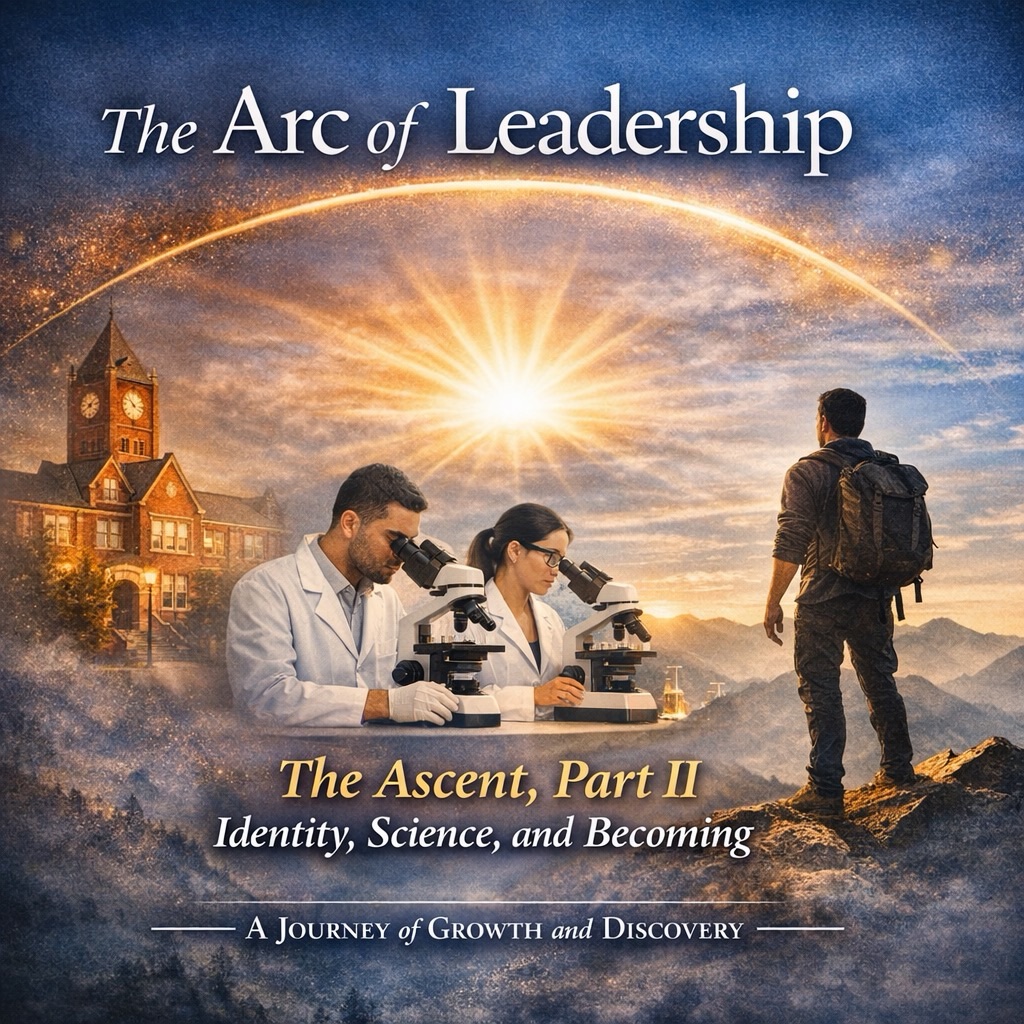
Identity, Science, and Becoming
College was the doorway I had been running toward my entire childhood. Growing up, very few people in my immediate family went to college. Some of my older cousins did, and I knew I was supposed to follow that path, but no one around me was quite sure how. My high school teachers and counselors were supportive enough, but I don’t think they saw me as “college material.” I wasn’t in the college‑prep track. I wasn’t groomed for it.
But I knew.
I knew because of the years after my parents divorced, when we went from stable to poor almost overnight. We lived in a series of small apartments, eventually landing in a place I still call “the slum.” The people were beautiful — some of my sister’s closest friends came from that time — but the poverty was real. My mother worked endlessly. My father paid minimal child support. And yet, through all of it, there was love, and there was the example of hard work.
Those years taught me that education was the only way forward.
So when the acceptance letter from the University of Connecticut arrived — thick envelope, lilac-scented air, sunlight hitting the side of our tiny rented house — it felt like the universe cracked open. I can still smell the lilacs. I can still feel the weight of that envelope in my hands. It was the happiest moment of my young life. I knew my direction had changed.
College was a world of expansion. New friends, new freedoms, keg parties in the hallway, sweaty dorm dances, and the exhilarating terror of taking academics seriously for the first time. I studied hard — harder than I ever had — because I was determined not to fail. I started in nutrition, then shifted to medical technology, drawn to the precision of lab science and the way the body reveals its secrets through values, patterns, and anomalies. I didn’t know it then, but this decision would become the backbone of my entire career in clinical research.
Leadership found me early. I became president of my dorm, then a Resident Assistant, then president of my fraternity, Alpha Phi Omega — a national service fraternity rooted in scouting, service, and community. APO was formative. It gave me lifelong friends, purpose, and my first real taste of leading people who wanted to make a difference.
By junior year, I became a Resident Assistant. By senior year, I was elected president of APO after a full campaign — door-to-door conversations, vote counts, strategy sessions. It was my first real experience influencing a group toward a shared vision. I didn’t know the term “servant leadership” yet, but I was already living it.
After graduation, I entered the medical technology internship at Hartford Hospital — a rigorous year of lab rotations, blood draws, and hands-on science. It was intense, demanding, and deeply satisfying. I stayed on part-time in the pharmacy research department, where I was exposed to Phase I studies in healthy volunteers. I even served as a volunteer myself — something that would never be allowed today. It was my first glimpse into clinical research, and it lit something in me.
I went back to UConn for graduate school in biopharmaceutics. My girlfriend at the time, Judy, returned to finish her degree and became a Resident Assistant herself. I became an Assistant Hall Director — my first experience leading leaders. Each RA had sixty residents. I was responsible for the people responsible for the people. It was the earliest echo of the director roles I would hold years later. My CliftonStrengths — Strategic, Learner, Achiever, Maximizer, Positivity, Relator — were already alive in me, even though I didn’t yet know their names. I loved mentoring those young leaders. I loved watching them grow.
But something deeper was shifting.
Judy and I had lived together for years, but now we were on opposite sides of campus. She was thriving in her dorm community. I could sense her connection with someone there. I tried to save the relationship — even planned a romantic evening with candles and a bubble bath — but something was off. We both felt it, even if we couldn’t name it. Not long after, in the Huskies Café, she ended things. I was heartbroken, confused, and unsure of myself.
And then I met John.
We met at Gold’s Gym. I had noticed him before — attractive, confident, magnetic. One day, after working out, we crossed paths in the locker room. A brief touch, a spark, a jolt of electricity that ran through my entire body. It was the first time I felt the truth of myself so clearly.
We met for lunch near our workplaces — Hartford Hospital for me, his company just a block away. We walked to a quiet courtyard of an old building, sat on the steps, and he asked if I had ever kissed a man. I hadn’t. So he kissed me.
It was gentle, lingering, sweet — and utterly life-changing.
In that moment, I knew.
Not tentatively.
Not with confusion.
With absolute clarity.
I was gay.
I was alive.
I was myself.
John told me about an opening at his company for a CRA. I applied. They tried to dissuade me because of the travel, but for me, the travel was the selling point. I got the job. I chose it over finishing my thesis — a bittersweet but perfect decision. It launched my career.
Those early CRA years were extraordinary. I traveled constantly — sometimes two weeks at a time — visiting investigators across the country. San Francisco became a second home, a place where I worked hard by day and explored my identity by night. Every city offered both professional growth and personal awakening. I learned the craft of monitoring from seasoned CRAs. I learned the discipline of science. I learned the responsibility of human subjects research.
In October 1992, I traveled to Washington, D.C. for a monitoring visit and found the AIDS Memorial Quilt covering the National Mall. Panel after panel. Name after name. Lives lost. Futures stolen. I walked among them and sobbed — openly, uncontrollably. The grief was overwhelming.
And yet, that same weekend, I danced all night at a circuit party, Martha Wash belting “It’s Raining Men,” joy pulsing through the room. It was a strange, impossible juxtaposition — fear and joy, grief and celebration, death and aliveness — coexisting in the same breath. That was the reality of being a gay man in the early ’90s.
The quilt changed me.
The community changed me.
The activism changed me.
It deepened my commitment to research.
It made the work personal.
It made the science sacred.
I saw medical records of people with AIDS. I saw the suffering. I saw the suicides. I saw the urgency. And I knew I wanted to be part of bringing treatments to people who needed them.
I worked for that company for four years, very hard, loved it, loved every single minute of it.
Professionally, I proposed the first regional CRA role at my company — a strategic move that saved money and allowed me to relocate to Miami. It worked. It opened doors. It set the stage for the next phase of my ascent.
Work eventually brought me to Florida — Orlando, then Miami, then Key West — where I met my first boyfriend, Orlando, and became a stepfather figure to his two daughters. After that relationship ended, I moved to Miami Beach, lived freely for a short time, and then met Juan at the Westend bar.
“Meet your best end at Westend,” they said.
And I did.
That was the beginning of our thirty-year story.
This chapter — college, leadership, heartbreak, awakening, science, travel, community, purpose — was the making of me.
It was the moment the boy with the flashlight became the man with the protocol.
The moment my identity, my vocation, and my leadership philosophy all ignited at once.
The moment my Ascent truly began.
Closing Reflection: The Moment You Began Becoming
Take a quiet moment. Let your breath settle into a natural rhythm.
- Bring to mind a time when your life was shifting — when you were stepping into a new identity, a new truth, or a new direction.
Notice what that moment felt like in your body.
- Ask yourself: What part of me was emerging then?
What new truth was rising, even if you didn’t yet have the words for it?
- Recall the people, mentors, or experiences that helped you cross that threshold.
Who believed in you? Who challenged you? Who opened a door?
- Place a hand on your heart and acknowledge the courage it took to step forward.
Let gratitude rise — for the journey, for the lessons, and for the person you were becoming.
Take one more breath.
Return gently to your day.

